[DIN Highlight] MegaETH
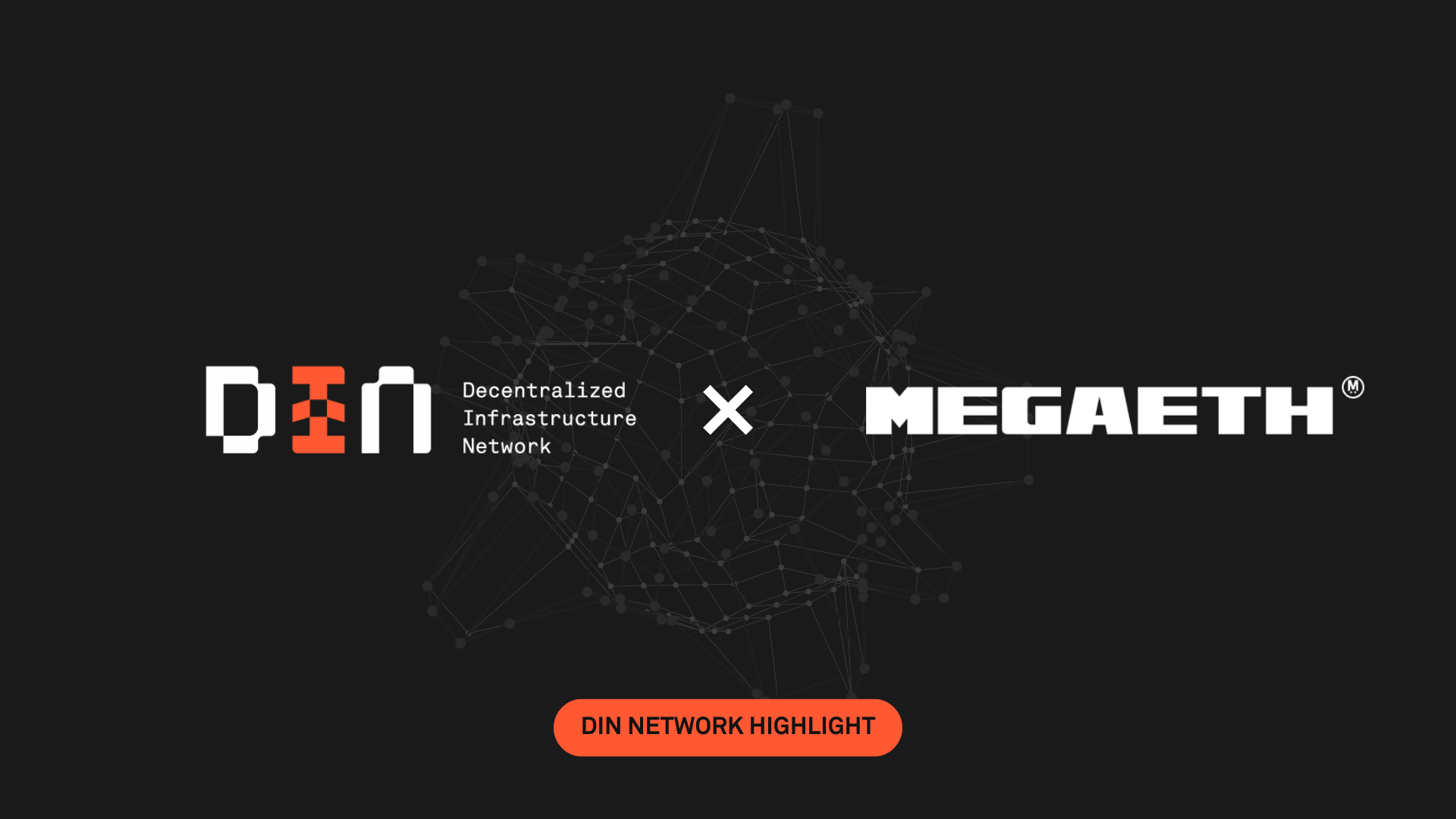
This week, we spotlight MegaETH, the world’s first "real-time" blockchain designed to eliminate the performance gap between decentralized networks and traditional cloud computing. Launching its mainnet on Feb 9, 2026, MegaETH is redefining Ethereum scaling by moving beyond "batch processing" into sub-millisecond execution. While most Layer 2s measure performance in seconds, MegaETH targets 100,000+ transactions per second (TPS) with 10-millisecond block times. It is the high-performance backbone for the next generation of consumer apps, high-frequency DeFi, and fully on-chain gaming.
1. Origin Story
MegaETH emerged from a shared vision between researchers at MegaETH Labs and the broader Ethereum community to push the EVM to its hardware limits. Backed by $57 million in funding from leaders like Vitalik Buterin, Dragonfly, and Figment Capital, the project was born out of the "Endgame" scaling philosophy. The mission was simple: build a rollup that inherits Ethereum’s security but operates with the responsiveness of a centralized server. Today, the network initiated its Global Stress Test, a massive 7-day event designed to process 11 billion transactions and prove that real-time performance is possible at scale.
2. Tech Stack: The 2026 Landscape
MegaETH’s architecture is built on "Real-Time Rollup" principles, specifically designed to remove the I/O bottlenecks that traditionally plague the EVM. It achieves this through a radical separation of node duties and hyper-optimized in-memory execution.
In-Memory Compute: MegaETH is the first blockchain to implement a native in-memory compute engine. By storing the entire blockchain state in RAM rather than on disk, the sequencer can access and update state data up to 1,000x faster than traditional methods.
Node Specialization: To achieve 100k+ TPS, MegaETH categorizes nodes into three distinct roles. Sequencers (heavy hardware) handle execution; Provers (lightweight) generate validity proofs; and Replica Nodes (standard hardware) receive state updates via an ultra-efficient P2P protocol.
Mini-Blocks (10ms): The network produces "mini-blocks" every 10 milliseconds. This frequency allows for near-instant transaction feedback, which is essential for applications like PvP gaming and real-time motion graphs where even a 100ms delay is noticeable.
Native Machine Code (JIT): MegaETH uses a Just-In-Time (JIT) compiler to translate smart contract bytecode into native machine code (C++ implementation). This optimization provides a 100x speed boost for compute-intensive applications compared to the standard EVM interpreter.
3. Feature Spotlight
The Global Stress Test: Launched alongside the mainnet on Jan 22, 2026, this test aims to maintain a sustained throughput of 15,000 to 35,000 TPS for seven days. This event demonstrates the network's production readiness by running high-load apps like Stomp and Smasher under continuous pressure.
USDm Native Liquidity: Through a partnership with Ethena, MegaETH integrates USDm as a native yield-bearing stablecoin. Yield from USDm reserves is used to subsidize user transactions, enabling "sub-cent" or even gasless experiences for consumer applications.
Stateless Validation: MegaETH utilizes a stateless validation model where provers do not need to store the entire state to verify blocks. This ensures that while the sequencer requires elite hardware, the network's verification layer remains decentralized and accessible.
4. Ecosystem Overview (The "MegaMafia")
The ecosystem, known as the MegaMafia, consists of over 30+ high-conviction projects that require the "real-time" speed only MegaETH provides. These projects represent a shift from speculative DeFi toward high-utility consumer products.
Real-Time Gaming: Apps like Stomp (PvP gaming) and Crossy Fluffle are at the forefront of the mainnet launch. These games utilize 10ms blocks to provide lag-free, multiplayer experiences where every action is recorded on-chain in real-time.
Autonomous Movement: Cilium is building a "real-time motion graph" on MegaETH for drones, robots, and self-driving vehicles. This project leverages the network's abundant compute capacity to process dynamic mapping data that static Web2 maps cannot handle.
Culture & Social: Hunch (social culture trading) and Blitzo (gamified payments) take advantage of the network's responsiveness to turn financial transactions into viral, social moments. These apps target the "TikTok generation" by making on-chain interactions feel as smooth as scrolling a feed.
5. Technical Node Requirements
MegaETH leans into hardware specialization to achieve its performance targets. This means the hardware rigor is concentrated on the sequencer, while validators remain accessible.
Sequencer Nodes (Data Center Grade): To support the real-time state, sequencers require 100+ CPU cores, 1TB of RAM (to hold the state in-memory), and 10Gbps symmetric networking. These nodes are verified by the Watchers to ensure they operate at the extreme boundaries of physics.
Full & Replica Nodes (Standard Grade): These nodes are designed for moderate hardware, requiring 4-8 CPU cores and 16GB-32GB of RAM. Because they utilize stateless validation and state diffs, they can stay synchronized with the 100k TPS sequencer using standard consumer-grade SSDs and internet connections.
Verification (DIN & Watchers): DIN’s infrastructure provides the necessary failover for these high-performance nodes. Our Watchers (secured via EigenLayer) monitor the sequencer's 10ms block production 24/7, ensuring that any "lag-drift" is instantly detected and mitigated to preserve the real-time user experience.
6. Why DIN?
For a network that produces a block every 10 milliseconds, there is zero margin for infrastructure error. The Decentralized Infrastructure Network (DIN) is the only system capable of providing the ultra-low latency and verifiable reliability that MegaETH demands.
Decentralized Failover: If a primary MegaETH sequencer or RPC provider experiences a micro-outage, DIN instantly reroutes traffic to the next most performant provider. This prevents the "desync" issues that can break real-time games or high-frequency trading bots.
Latency Proximity Markets: DIN enables node providers to specialize in regional proximity. By routing MegaETH requests to the node physically closest to the user, DIN ensures that the 10ms block speed isn't wasted by 200ms of network travel time across the globe.
7. Roadmap & Governance
The 2026 strategy for MegaETH focuses on transitioning from the Global Stress Test into a fully mature, decentralized economy. The network is governed by MEGA token holders through a KPI-based staking model.
$MEGA Token Generation (Jan 2026): Alongside the mainnet launch, the MEGA token (10 billion supply) has officially entered circulation. It serves as the native gas token, staking asset for sequencer rotation, and the primary vehicle for DAO-driven builder grants.
KPI-Based Staking: Unlike traditional fixed-emission models, MegaETH’s staking rewards are tied to measurable network progress—specifically uptime, sustained TPS, and the growth of the "MegaMafia" ecosystem.
Sub-Millisecond Targets: Post-launch upgrades aim to push block times even lower, targeting the 1ms threshold. This will enable even more advanced use cases, such as on-chain physics engines and global-scale high-frequency order books.
8. MegaETH + DIN: The Speed of Reality
MegaETH is redefining the blockchain landscape by proving that decentralization does not have to come at the cost of performance. We will be launching a DIN SDK where MegaETH can be directly accessed by developers and paid with x402 via stablecoin.
9. Useful DevOps Resources
🖥️ Node Operator & Hardware Specs
MegaETH Node Roles & Hardware: https://megaeth-co.gitbook.io/mega-docs/deep-dive/architecture/node-specialization
Essential for DevOps to understand the specialization: Sequencers (100+ cores, 1TB+ RAM for in-memory compute), Full Nodes (Standard enthusiast specs), and Replica Nodes (Lightweight state diff recipients).
Stateless Validation Guide: https://www.megaeth.com/research
Technical deep dive into how MegaETH allows full nodes to verify transactions in parallel without holding the entire state on disk—critical for cost-efficient scaling.
🛠️ Infrastructure & Monitoring (DevOps Stack)
Goldsky Real-Time Indexing: docs.goldsky.com/chains/megaeth
The primary data pipeline for DevOps providers. Features Mirror for real-time data replication into your own sink (Postgres/S3) and subgraphs for high-speed API serving.
Mega CLI Tool: github.com/awesamarth/mega-cli
A unified CLI for DevOps to manage accounts, request faucet tokens, and spin up local development environments using Foundry.
⚙️ Developer & API Reference
Kumbaya DEX Integration Docs: docs.kumbaya.finance/developers
Reference for the primary liquidity layer used in the 11-billion transaction stress test; essential for builders of high-frequency trading bots.
Standard Beacon API for L2: ethereum.github.io/beacon-APIs
MegaETH follows standard Ethereum API specs for its consensus layer, making it compatible with existing Ethereum observability tools.
💡 DevOps Pro-Tip: RAM-as-a-Disk
In 2026, standard NVMe storage is often the bottleneck for MegaETH's 100k TPS. For top-tier performance, DevOps providers should configure Sequencer Nodes to use a RAM-disk (tmpfs) for the state trie or deploy on instances with High Bandwidth Memory (HBM) to maximize the throughput of the native in-memory compute engine.