[DIN Highlight] Celo Network
This week, we spotlight the Celo Network, a mobile-first blockchain that recently completed its transformative migration to become a Layer-2 on Ethereum.
1. Origin Story
Celo’s journey began with a distinct humanitarian mission: to create a financial system that creates the conditions of prosperity for everyone. Launched on Earth Day 2020 by Rene Reinsberg, Sep Kamvar, and Marek Olszewski, Celo initially operated as an independent, carbon-negative Layer-1 blockchain designed for mobile users in emerging markets. Recognizing that Ethereum had won the liquidity and settlement wars, cLabs proposed a strategic pivot in 2023: "come home" to Ethereum.
In March 2025, Celo successfully executed a hard fork, migrating its state to an Ethereum L2. This transition combined Celo’s mobile-first identity primitives with Ethereum’s unparalleled security, positioning it as the "Real World Asset" (RWA) and payments layer of the Ethereum ecosystem.
2. Tech Stack
Celo L2 utilizes the OP Stack, Optimism’s modular framework, ensuring full EVM equivalence and allowing Ethereum developers to deploy existing contracts without modification. However, Celo’s architecture makes a critical deviation to solve for cost. To maintain the sub-cent transaction fees required for global payments (often <$0.001), Celo utilizes EigenDA for data availability instead of posting full data to Ethereum L1.
This makes Celo one of the first major "Optimiums" in production which is securing the chain via Ethereum settlement while outsourcing data storage to EigenLayer’s decentralized operators. This hybrid approach allows Celo to maintain 1-second block times and high throughput while inheriting Ethereum’s economic security.
3. Feature Spotlight
Celo’s architecture is purpose-built for mobile payments and real-world utility:
SocialConnect: A decentralized identity protocol that maps phone numbers to wallet addresses. This allows users to send crypto to a contact (e.g., +1 555-0199) rather than a complex hexadecimal string, dramatically lowering the barrier to entry.
Fee Abstraction: On Celo, users don’t need to hold the native governance token (CELO) to pay for gas. The protocol natively accepts stablecoins like USDC, USDT, and cUSD for transaction fees. This creates a seamless "Web2-like" experience where a user holding only stablecoins can still transact freely.
Ultragreen Money: Celo maintains its carbon-negative status even as an L2, with protocol-level logic that continues to offset carbon emissions for every transaction processed.
4. Ecosystem Overview
Since its migration, Celo has cemented its status as a payments and Regenerative Finance (ReFi) hub. The network powers MiniPay, a stablecoin wallet embedded inside the Opera Mini browser, which has onboarded over 11 million active wallets across Africa.
The ecosystem is anchored by deep stablecoin liquidity, with over $1 billion in monthly stablecoin volume facilitating real-world commerce. Key DeFi and ReFi projects include Toucan Protocol (tokenized carbon credits), EthicHub (crowd-lending for farmers), and Uniswap V3. The seamless L2 architecture has also attracted major RWA players, with Tether Gold (XAUt) and localized stablecoins seeing rapid adoption for savings and payments in high-inflation regions.
5. Why DIN?
For a network managing daily payments for millions of users in regions like Kenya, Nigeria, and Brazil, infrastructure reliability is not optional. It is critical. Decentralized Infrastructure Network (DIN) plays a vital role in Celo’s L2 era.
Payment Reliability: If a centralized RPC provider goes down, a user at a checkout counter can't buy groceries. DIN provides failover protection, automatically routing requests to healthy providers if one fails, ensuring 100% uptime for apps like MiniPay.
Global Latency Reduction: DIN’s network of providers allows RPC nodes to be spun up closer to the user. For Celo’s heavy user base in the Global South, this edge computing approach reduces latency, making crypto payments feel as instant as cash.
Censorship Resistance: As an L2 serving global finance, Celo relies on DIN to ensure that no single infrastructure provider can gate access to the network, maintaining the ethos of permissionless finance.
6. Roadmap & Governance
With the L2 migration complete, Celo’s roadmap for late 2025 and 2026 focuses on decentralizing the sequencer. Currently centralized for efficiency, the network plans to open sequencer roles to a set of validators, likely requiring CELO staking, to remove single points of failure in transaction ordering. Governance is also evolving through Regional Hubs (e.g., Celo Africa, Celo Europe), moving away from a central foundation to localized DAOs that better manage merchant acquisition and developer support in their specific territories. Additionally, Celo is exploring deeper integration with the Optimism Superchain to enable seamless interoperability with other OP Stack chains like Base and OP Mainnet.
7. Community & Developer Onboarding
Celo welcomes developers with a rich set of tools and incentives. Because Celo is EVM-equivalent, tools like Hardhat, Foundry, and Remix work out of the box.
Grants: The Prezenti grant program and Celo Public Goods funding offer resources for builders, particularly those focusing on ReFi and mobile dApps.
SocialConnect SDK: Developers can easily integrate phone-number-based payments into their dApps using the open-source SocialConnect kit.
ReFi Focus: Celo is the premier home for "Green Pill" developers. If you are building for climate action, financial inclusion, or UBI, you will find a highly aligned community and specific funding pools for these verticals.
8. Celo + Infura: Available Now
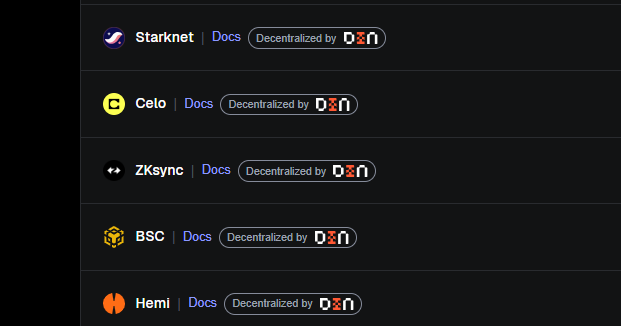
Available on https://developer.metamask.io
Accessing Celo L2 is immediate and simple for existing Infura users. Celo is fully integrated into the MetaMask Developer dashboard, supported by the failover capabilities of DIN. Developers can add Celo Mainnet or Alfajores Testnet to their project with a single click. Because Celo traffic is routed through DIN’s multi-provider network, you get enterprise-grade reliability without managing complex node infrastructure. Whether you are migrating an existing Ethereum dApp to capture mobile users or building a new stablecoin payment rail, the infrastructure is ready today.
9. Resources
Ready to build the future of mobile finance?
Official Website: https://celo.org
Developer Documentation: https://docs.celo.org
Celo on MetaMask Docs: https://docs.metamask.io/services/reference/celo/
Celo on L2 Beat: https://l2beat.com/scaling/projects/celo
Twitter/X: https://x.com/Celo
Ecosystem Analytics: https://dappradar.com/rankings/protocol/celo
By combining the speed of an L2, the cost-efficiency of EigenDA, and the reliability of DIN, Celo has built the ultimate platform for bringing crypto to the real world. Happy building! 🚀